

Siblings (n.): two or more people with the same parents; those people in our immediate family whom we think of as peers; brothers and sisters. They flank us in birth order, haunt our privacy, insert their wisdom unbidden, taunt our vulnerabilities, and watch our backs. Because they know the subtle chinks in our armor, siblings have the power to infuriate us as well as defend us. They love us, humor us, humble us, support us, drive us to the brink of our sanity, and yank us back from the edge lest we fall. They are our friends, mentors, devil’s advocates, cheerleaders, critics, confidantes, and comrades. No one can hurt us like they can, but no one can make us laugh harder or feel more loved, appreciated, and whole. The sibling relationships in our family constitute a long list.
Sunday, September 6, 2009


 Visiting family in Kinder.
 Circa. 1934
Not only were they close in age, Jennetta was just three years older than Louis, but close in spirit as well. Because of Louis’ death at nineteen, their time together was short, but their relationship is remembered as close and supportive. Their interests were different, Louis loved and excelled in sports while Jennetta preferred sewing, but they both liked to dance together when the family went to community dances. While they lived in Louisiana, Louis was taught by the old men sitting outside the entrance to the general store to dance a jig while they played music. Jennetta long remembered seeing him, at five years old, trying to keep his feet going for as long as the fiddlers picked. In Oregon, Louis taught Jennetta to swim on family picnics to the lake, but she had a hard time conquering her fear of the water. Later, when Louis became mentally ill, at about eighteen, from constant ear infections and began having violent episodes, it was his sister who, as his closest living relative, had to sign the papers to have him institutionalized. Sitting across the table from him and having him smile over at her made it the hardest moment in her life.
 William, far left; Letha (black jacket) & Marvin, right.
Marvin was the youngest of his siblings, Letha was the oldest and William was in the middle. With about 12 years difference in their ages, Marvin often said that sometimes Letha was more like a mother to him than a sister as he was growing up. When he was in the third or fourth grade, at Helix Elementary, Letha was his teacher and she sadly told him at the end of the year that she needed to hold him back so that she wouldn’t be accused of favoritism. He was never sure if that explanation was true or just an invention to make him feel better. Bill, who lived with his wife and three children in Pendleton, died of a heart attack in his forties, but Letha and her husband, Bud, eventually came to live in the same town in which Marvin and Jennetta had settled and their connection remained strong for the rest of their lives.


 Taken in K-Falls
 Circa. 1960
Circa. 2000
Coletta and I are 14 1/2 years apart. She was in high school when I was born, but instead of being embarrassed by my birth, she was excited to the point of annoyance to everyone else. Mom often lamented that most of my baby pictures have the back of her head blocking my face. She was reluctant to let anyone else hold me and whispered to Mom and Dad that Mamoo, my sweet grandmother, might drop me. Mamoo chuckled, Mom and Dad did not. We grew up almost separately, but our kinship stayed in tact because our small family came together so regularly. Although I often rebelled against her tight hold, and we are sometimes more different than alike, we stay connected. I cannot image life without such unconditional love.
 Circa. 1961
 K-Kids generation 2. Circa. August 2009
 These siblings have too many stories to tell in one sitting. They involve sitting in a bucket, climbing onto the roof, a smoking apple tree, paper delivery, lawn mowing and bottle collecting enterprises, making a huge chocolate chip cookie for Dad, a broken windshield, Killer Slap Jack, sneaking in the playroom door at night, trips to Mt. Angel, birthdays at the beach, discovering beautiful pebbles in Grandpa's driveway, rolling backwards at the dump, and cutting off a very long hair braid.


Monday, July 6, 2009
Betty Jean

 Circa. 12-25-1935
Elizabeth Jean H., the eldest of two children, was born on July 6, 1930 in a maternity home in Hood River. Her parents, Howard and Hazel, lived with Howard's widowed mother (in the house pictured above) so that he could help with her registered dairy cows and milk route. From first through seventh grade Betty attended Franklin Grade School, which was just across the road at the end of their driveway. She fondly remembered sliding down the metal fire escape many times, using waxed paper to make it more slippery.

In 1943, after her father became Chief of Police, the family moved into Hood River to the house at 715 Prospect Street, where this picture was taken. On July 8, 1947, before she began her senior year, her dad died suddenly of a second heart attack, leaving Hazel alone with her two children, Betty and Dick. While her mother went to work in a grocery store to support them, Betty and her brother, who was two years younger, took on after-school jobs so that they could help by each being responsible for paying one monthly bill

After graduating in 1948, Betty attended Northwest Business College in Portland, then returned to Hood River to work for 85 cents per hour as a personal secretary for the manager of the canned goods department of Apple Growers Association.

Although, as this receipt shows, Betty's $8.00 birth fee is cheap by today's standards, she was priceless to us. The photo above of her with long, wavy hair is one of my favorites because I see my own children reflected in her. That picture, along with her story, is a gentle reminder that she was once a vulnerable teenager who went through some tough times. Because of the great person she turned out to be, she has taught us that who we become is a choice, not just an accident of circumstance. She chose to help her mom, she chose to be a good sister, she chose not to become bitter or use misfortune as an excuse for ego centricity. Elizabeth Jean grew up to be a loving mom, wife, sister, grandma, and friend who touched the lives of everyone around her in a positive way. We can honor her best by making the same positive choices in our own lives.
 Circa. 1947
Monday, June 22, 2009
A Family Man

This is a stubborn old goat whom we all dearly love. He could sometimes be sharp of tongue and rigid in his determination to be right, but the love he had for his family was clear. Born October 7th, 1926 to Blanche and Boots K, Vern Wray K. married his beloved Betty H. in 1949 and together they raised six children. His love of Betty prompted him to study Catholicism and be received into the Church and he often said that Betty not only gave him six wonderful children, but also a faith. In very quiet ways he continually put his family first and tried to keep a simple life enjoyable. When the kids were little, he quit smoking in hopes that they would not be as likely to take up the habit. At vacation time, he found a way to take everyone to the beach on a tight budget. When he played games with his children, and later his grandchildren, he gave no favors and made them win on their own so they could enjoy the feeling of a true victory. His rules of conduct were so strict that, even as grown children, his kids had to rename the card game “Oh Shit!” to “Oh Crap!” so that he would play.
 A banker for 37 years, Vern taught his children honesty and integrity through his own example as he dealt with the public. Everyone entering the doors of First National, which later became First Interstate, was treated with respect. Over and over again people have told us that, as newcomers to town they were first welcomed by Vern and instantly made to feel comfortable and part of the community. He had a gift for conversation and Betty often commented that he knew no enemies and could make an acquaintance of anyone. Indeed, when we took them to the beach in 2001 and stopped at the Evergreen Aviation and Space Museum in McMinnville, we lost Vern at one point in the huge building full of the Spruce Goose and other historic planes. Finally, Betty pointed him out lounging in a chair next to a complete stranger, shooting the breeze and making yet another friend.
As Vern was raised to do, he kept his feelings close to his vest, but this tendency softened somewhat in later years. When I painted windows at one of the two branches he managed in the eighties, the employees laughingly told me that Vern was a master at always managing to somehow bring his kids into a conversation with absolutely anyone on a daily basis. The only thing that interrupted this tendency was the birth of his grandchildren, and then pictures came out along with the grandparent stories. Although he may not have said it enough to those he loved, the rest of the community knew how proud he was of all of his children and grandchildren. I have often thought that the feelings he had for them ran too deep for him to express in their presence. An addition to the family through marriage, I was touched by his tenderness. He worried aloud to me once in awhile about something affecting his kids or Betty and his candor always took me by surprise. The words seemed to slip out of their own accord and his eyes always looked quite vulnerable, hoping for an answer. Similarly, he could tell me how proud he was of Don, but not say it to Don, himself. Or, he could tell Don how proud he was of one of his siblings, but not tell the sibling. Yet, he never gave up sacrificing and trying to do his best for his family and, as Betty knew well, he might not admit he was actually wrong about something, but love would eventually bend him 180 degrees. This is a good man who loved his family more than anything. His stubbornness, honor, and honesty are now a solid part of his children and grandchildren and we are all privileged to have had him as a father, grandfather, and friend.


Sunday, May 10, 2009
Grandmothers
 Grammy
- Was a natural grandparent even though she had only had role models for a very short time.
- Made your favorite thing for lunch on school days and then traded you your lunchbox sandwich for it.
- Watched you every recess that you played outside in the schoolyard.
- Let you play in the flour drawer.
- Let you help her bake and roll out biscuits.
- Stood next to you and just watched you sleep when you were a baby.
- Never complained about babysitting you.
- Sewed for you.
- Called me after lunch to tell me if you said something was wrong at school.
- Read to you for hours.
- Played games with you and taught you to play Rummy.
- Always asked if it was okay to pick you up before she did it when you were a baby.
- Loved going to your school concerts, sporting events, and church celebrations.
- Has prayed for you everyday since before you were born.
- Sincerely thinks you are the brightest, best looking, most considerate grandchildren anyone could ever have.
- Wants you to be happy, loving, sincere people.
Grandma
- Was excited to become a grandparent.
- Would whisk you out of my arms when we went to visit before we ever crossed the threshold of her house.
- Kept scrapbooks of you even before scrapbooking was a popular art.
- Woke you up to change your diaper just because she couldn’t wait any longer to hold you.
- Said it was an honor to babysit you.
- Made sure Santa left stocking gifts for you at her house.
- Sincerely thought you were amazing and was awed by you.
- Made the sewing nook in her bedroom a cozy spot for you to sleep as babies and toddlers.
- Sewed your baptismal blanket and embroidered your name and the date on it.
- Gave you a nickname.
- Made you a special teddybear.
- Gave you a Christmas ornament every year and brought you little gifts from her travels.
- Told everyone how wonderful she thought you were.
- Kept pictures of you in her purse to show to people.
- Prayed for you every day.
- Wanted you to be a happy.
Tuesday, March 31, 2009
No April Fools

Moved back a day to avoid April Fools Day, Marvin and Jennetta were married on March 31, 1937; that’s 72 years ago today. Father George Murphy performed the 7:30 a.m. ceremony in the chapel of Sacred Heart Church in Klamath Falls rather than on the main altar because Dad was a non-Catholic. Afterwards nineteen people, including family members and a few close friends, gathered at the home of Blanche and Jasper Cole for a wedding breakfast. Blanche had fried six chickens early that morning for the feast. Since the newlyweds had no car, they rode to Portland with Marvin’s parents, Lydia and William, stopping at Crooked River Bridge Park for one of Mamoo’s infamous salmon sandwiches. Needless to say, after one bite Mom relinquished hers to Dad. After depositing Dad’s parents at their home in Portland, the newlyweds spent the night at a hotel and took Granddad’s car to visit Marvin’s brother and sister-in-law in Pendleton. Several days later they took the car back to Portland and then returned to Klamath Falls by train.

Sister-in-law Georgie & Jennetta
Although they started out poor as church mice, married in a chapel instead of a church, with a honeymoon spent with family in a borrowed car, the couple’s vows carried them through good times and bad, sickness and health for just short of 60 years before Marvin died in February of 1997. They understood each other, aggravated each other, admired each other, made all their decisions together, and loved each other. Mom once said that she could still remember sitting at Aunt Blanche’s sewing machine before they were married and looking out the window in time to see Dad walking down the street with his hat tipped jauntily to one side. Even though they had separated for a time because of their differences in religion (Catholic vs Baptist), she knew he was the only one for her and she was just waiting for him to figure out the same thing. Sure enough, he did and they spent their married life respecting one another’s beliefs and focusing on what they had in common. In later years they quietly studied their bibles together in the early morning hours while drinking their first cups of coffee.
 Georgie, Marv, brother Bill, & niece & nephew JoAnn & John
Two months before Dad died, he told me how beautiful he thought Mom was. I will never forget the inflection in his voice. Twenty-four hours before he died, as Mom was feeding him tapioca, she asked if he knew who we were. After he nodded, she prodded, “Say my name.” It took some internal work on his part, but in spite of encroaching dementia he looked her in the eye and spoke her name in syllables, “Jen-net-ta” and smiled. Their kind of bond was not showy or demonstrative, but it sure was strong, durable and blessed.
Friday, March 27, 2009
Blanche & AJ: A Love Story
 circa. 1923
Only a year older than her, Boots had run away to Oregon several years earlier. Doing everything from clean up to working in the treetops to being a choker, hard work and discipline eventually earned him one of the hightest paid jobs in the logging industry. Called a powder monkey, he set the dynamite charges that cleared the way for laying down train tracks that were used to haul out the logs. In time, these two kindred spirits decided to get married. While Blanche managed to get permission to take a day off for the event, Boots did not. Long on determination and stubbornness, they quit their jobs, got married and found work elsewhere.
This quiet love story of your fraternal great grandparents did not end there. It went on for over 50 years until Blanche died unexpectedly from a blood clot that broke loose during her recuperation after hip surgery. Side by side they worked, raised two boys, hunted, fished, and in their retirement, traveled around in their camper going to rock shows, collecting rocks that they made into tables, clocks, and jewelry, and visiting grandkids. So compatible were they that it was hard to tell where one left off and the other began. Each seemed to be the other's best friend and greatest admirer and neither needed anything else to feel complete. Their lives were simple but connected, quiet but strong, and inextricably linked. What more could any of us hope for in our own relationships?

Saturday, February 21, 2009
Fathers

This is my daddy. I couldn't let today go by without pausing to say this, to let him know that I remember, because it is his birthday and he deserves remembering. He was born on February 21, 1913 to William and Lydia A. in Helix, Oregon. Born in his maternal grandmother's house just around the corner from the A. home, his sister, Letha, remembered hearing his first cries coming from an upstairs bedroom. His father was strict and his mother was sweet tempered and loving. His sister was like a second mother and even was his teacher in about fourth grade. His job at that age was to feed the pigs - a job he hated.
Times were different then, and sometimes it sounded like he grew up half wild, working hard and playing hard. When his family went to Lehmen Hot Springs in the summer people would flip coins into the pool to watch him dive in and retrieve them, putting as many in his mouth as he could before surfacing. The trouble was, he couldn't swim. Tired of repeatedly fishing him out of the pool, his dad finally told him he couldn't dive in any more until he learned to swim.
He was a teenager during prohibition and delivered moonshine as well as groceries. However, the loss of all his savings in the stock market crash forced him to adjust his dream of becoming a medical doctor to going to embalming school instead. After working for years as an employee in two different funeral homes in Klamath Falls, he and Mom had saved enough to buy their own business in Condon.
I came along late in their lives; Mom was 40 when I was born. It had been 14 years since the birth of their first child. Yet, despite the embarrassment such a late pregnancy might have caused and the 20 year commitment that another child called for, they were glad. I was raised with love. My dad was a good man; not perfect except in my eyes, but good, strong, and loving. He kept me safe, taught me art, and took me fishing. He was my hero, as every dad should be. Happy birthday, Dad. I love you.
Sunday, February 1, 2009
Mothers
 Mom was only about five when she went to live with her father’s sister and brother-in-law, eight when they moved west, and about ten when her mother died. Although she regarded her Aunt Blanche and Uncle Jap with the same closeness as parents, and they loved her and her brother like the children they could never conceive, Mom remembered her parents enough that she reserved the titles Mom and Dad for them. This picture was taken in front of their home in Klamath Falls, Oregon. For all the world, it reflects a mother/daughter relationship and the budding friendship that grown children often develop with their parents. Although this photograph was taken when Mom was still a teenager, it reflects their relationship the way I remember it. From the time I was little, Mom and I would go to Klamath for a week or two every summer. Mom would do things around the house to help Aunt Blanche and some afternoons we would go for a walk downtown or to visit Nana Ward down the street. But mostly they would laugh and visit, from early morning until 10:00 p.m. when we adjourned to our rooms for bed. The only break came after lunch when everyone took a nap. (The southern tradition of a siesta managed to survive their move to the West.)
  This is me with Mom when I am about five. We are standing in front of the house that is connected to the back of the Liberty Theater in Condon, where my aunt and uncle on Dad’s side lived at the time. My dress is one of many that Mom made for me, and I suspect she made her own as well. My shoes are those blasted “corrective” oxfords that I was doomed to wear all through grade school because they had better arch support. (They corrected nothing, by the way.) Notice Mom’s stylish shoes, though. She didn’t dress this way for the picture; she did her housework and gardening in the mornings in pants or a housedress, made lunch for us, took a nap, and then took a bath and always dressed up like this by about 2:00 in the afternoon. She learned this from Aunt Blanche.
I hope my children have positive images and memories from their childhoods, as I do from mine. I used to lie on Aunt Blanche’s bed and watch her in the mornings put on her make-up and comb her long hair before twisting it up onto the back of her head. She wound it in a figure eight, securing it with long, wide wire or tortoise shell hairpins. It fascinated me how she could do it so easily without being able to see what she was doing. Her hair was thick and wavy and she would comb the top of it with her fingers to loosen it just enough to let the wave show. Mom’s morning routine was much the same; predictable, systematic, and comforting to a child. Both of them wore jewelry, most of it costume pieces, which I loved to browse through and now cling to because of the memories they evoke.
Aunt Blanche made a loving home for my mom and Mom made the same for me. We were steeped in traditions, rules, and faith enough to keep us safe, build our confidence and sense of belonging, and equip us with the strength to venture out on our own. There was never any question but that we were incredibly loved and special. It is an amazing power that the mothers in our lives can wield. We want to become separate from them, and that is actually what they prepare us for, but then we find ourselves coming right back to take up new residence as more of a co-equal; a friend, as much as an offspring.
I admire these two women; they are very different and yet, the same. Both are generous and kindhearted to a fault, but as stubborn as the day is long. One loves to cook and the other only tolerated it, but they both loved children and animals intensely and constantly took in strays of either. Aunt Blanche rented her rooms to borders to pay the bills and nursed Uncle Jap for twenty years after he became an invalid with first Polio and then a stroke and Mom took care of Dad when he suffered from Emphysema and Dementia. Aunt Blanche took care of Mom when she was little and Mom reciprocated when Aunt Blanche was older. Through their examples I learned compassion, kindness, and fortitude, when and how to ask for forgiveness, when to stand up for myself and draw a line in the sand, and the difference between service and slavery. Neither had a career beyond the home, yet they were definitely equals in their marriages. Humor got them beyond tough times without the taint of bitterness and helped them deal with life’s incongruities. I am not exactly like either one of them, but I am who I am because of them.
Saturday, January 24, 2009
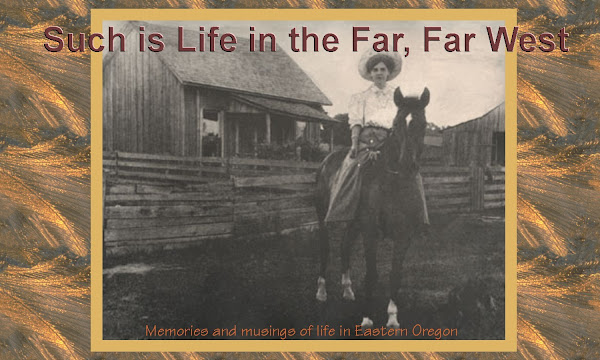
She Said, "Such Is Life In the Far, Far West!"
 Although I called her Aunt Blanche, like my mom did, she was really a great aunt to me. The youngest of nine children, she was raised in Kinder, Louisiana. Her dad raised horses and while her sisters stayed in the house to help with housework and needlework, and her brothers worked outdoors, Blanche played on her own and went riding. At that time in the South women were only to ride side-saddle, but as soon as she was out of her parents' sight, Aunt Blanche rode astride, even in a skirt. She expected a tongue lashing when her strict father finally caught her in the act, but all he said was, "So you finally got smart!"
It is fitting that this blog is named in honor of Blanche's spirit. When life was unfair, confusing, or just plain boring, she would shrug her shoulders, sigh, and say in an offhand way, "Such is life in the far, far West." She could say that with authenticity since, in 1921, she and her husband, Jasper, had taken the two young children they had adopted and moved to the West, far from everything familiar to an unknown way of life. After traveling for days in an open train car, and the last miles from Weed on a flatbed car, they set up house in Tenement, California for a short time and then moved farther north to Klamath Falls, Oregon.
I wonder if the move was an adventure befitting her daring nature, or if she went because it was sensible, expected, or out of love. I suspect it was all of the above. Was she ever scared or lonely? Probably. It is nothing these days to relocate even farther from family than Blanche and Jasper did, but in the early 1900's the concept of a new beginning could also spell isolation. It was a gamble, and at times it was a hardship, but they made it work. In Louisiana families settled near each other on family settlements, but in Oregon they were alone and on their own. In Louisiana everyone took afternoon naps to avoid the muggy heat of the day, but in Oregon life went nonstop from dawn until dusk and the harsh winters were only rivaled by the hot, dry summers. But then, such is life in the far, far West.
Blanche did keep in touch with her family through letter writing and even made it back to Kinder at least once for a visit. In turn, one or two of her sisters and one brother eventually visited in Klamath Falls. Years later, Mom called one of the surviving sisters with word of Aunt Blanche's death and was told that she had just dreamed of her sitting on the edge of her bed and had visited with her for a long time. I suppose it was just a dream, but I can't help but believe that it was also a convenient medium for a headstrong girl, determined to say goodbye in her own way, to connect one more time. After all, I am sure that it was Aunt Blanche who woke me up that same night. Blanche teaches us that family ties are strong and that distance does not weaken those ties; that love gives us the wings to both follow our dreams as well as to find our way home; and that our spirits are strong and stubborn.
Subscribe to:
Comments (Atom)